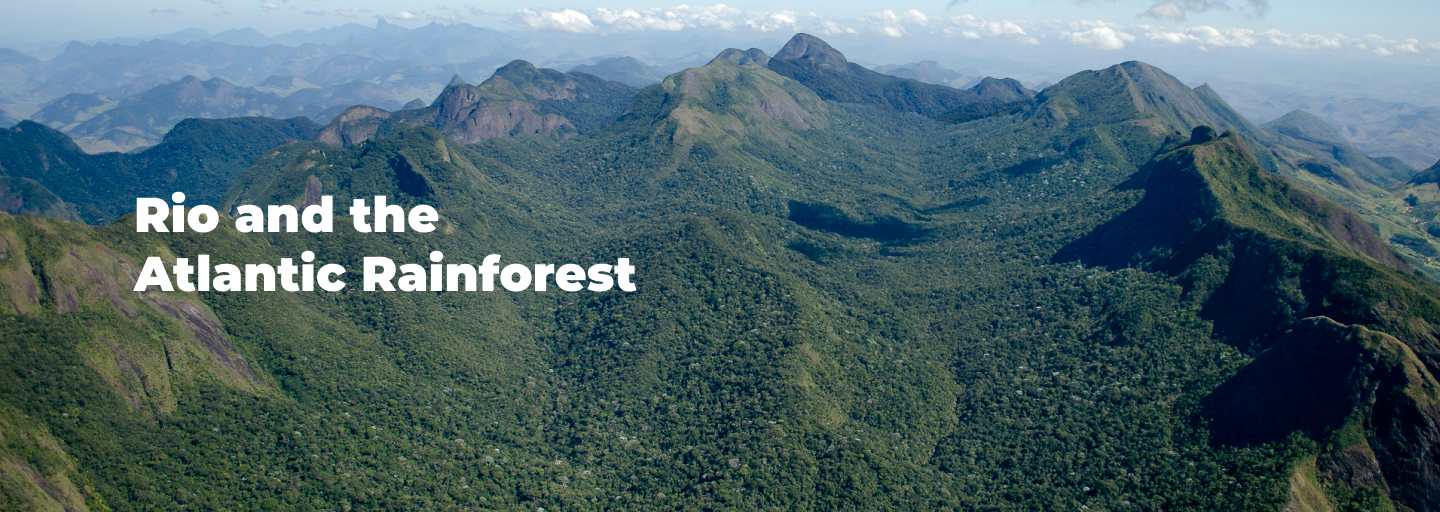
Photo by Letícia Riski
The Brazilian Atlantic Rainforest, since 1992 recognized by the United Nations Educational, Scientific, and Cultural Organization (Unesco) as a Biosphere Reserve, is a biodiversity hotspot, with more than 1,300 vertebrates and 560 endemic species identified. In addition, it provides ecosystem services for 140 million people, and contributes, for example, to water supply and air quality. At the same time, the biome region concentrates 80% of the national GDP, is home to 40% of the country's rural establishments and produces about half of the food consumed by the population.
The Atlantic Rainforest is the most devastated and anthropized biome in Brazil: it has already lost almost 90% of its original area and is highly fragmented. Of the species threatened with extinction in the country, 2/3 are concentrated in this region. Because of this, actions in favor of its conservation and recovery are a priority
Rio de Janeiro has an outstanding position for biodiversity conservation due to its high species richness and a large proportion of vegetation remnants in good conservation status covered by protected areas. The state of Rio de Janeiro has the largest proportion of preserved Atlantic Forest and Campos de Altitude, ranks fifth in terms of plant diversity per state in this biome (884 species are considered endemic) and tops the list of endangered flora species in Brazil.
Huge historical investments and actions to curb deforestation (such as increased control, enforcement, and penalties for illegal deforestation) and to promote conservation (creation, expansion, and management of legally protected areas) in Rio de Janeiro have brought positive results in reaching the global goals for biodiversity conservation.
At the present time, Rio de Janeiro has 1.3 million hectares of native vegetation, which corresponds to about 30% of its territory covered by Atlantic Forest, and more than half of this area is legally protected.
Approximately 30% of the continental areas (1.2 million hectares) and 10% of the maritime area in the state (181 thousand hectares) are protected by Conservation Units, representing a relevant and comprehensive mosaic of protected areas. The Conservation Units are home to 86% of the endemic flora threatened with extinction, which highlights their relevance and effectiveness for protecting biodiversity.
It is one of the few states in the country with almost zero deforestation (loss of vegetation below 100 hectares per year) since 2010, according to a report by SOS Mata Atlântica/Inpe, and important advances have been made towards increasing forest cover, through restoration programs and payment for environmental services. It is favorable and a great opportunity to foster and encourage sustainable businesses, opportunities to generate technologies, service offerings, research and innovation related to conservation, ecological restoration, and regenerative and sustainable agriculture.
Despite the positive results, we need to overcome challenges to halt biodiversity loss by 2030 and promote positive net gains by 2050 to live in harmony with nature.
We can and must advance the management and implementation of protected areas, the expansion of conservation strategies for terrestrial, aquatic and marine ecosystems, the promotion of increased forest cover in the state, and increased positive incentives and continued funding for biodiversity conservation. We have an environment Inea and Seas adopt the following priority agendas for action:
Progress in the implementation of the Conservation Units in the state of Rio de Janeiro
Increase connectivity and implement ecological corridors
Improve conservation of inland waters and coastal and marine ecosystems to reach the 30x30 target
Preserve and reintroduce endangered species
Foster scientific research, visitation, knowledge dissemination, and recreation in contact with nature
Promote economic growth and social inclusion having nature as a strategic ally, with the generation of employment and business opportunities associated with tourism and valuing the knowledge of native peoples and local communities
Fight deforestation (zero deforestation)
Reverse degradation of terrestrial, aquatic and coastal-marine ecosystems
Strengthen the enforcement agencies and the monitoring systems with technology and intelligence
Strictly punish those responsible for any illegal activity, be it illegal mining, logging, timber extraction, or undue occupation
Raise the coverage of native vegetation in the territory of the state of Rio de Janeiro from 30% to 40% by 2050 through the restoration of 440,000 hectares, prioritizing areas relevant to the provision of ecosystem services
Promote the recovery of permanent preservation areas (springs, riparian forests, sloping areas and hilltops), which represent 20% of the state's territory
Multiplication, production and reintroduction of seedlings of endemic, threatened and climatic species
Increase the regeneration and permanence of naturally regenerated forests
Expanding the adoption of Nature-based Solutions to promote food security, water security, climate change mitigation and adaptation, and natural disaster risk reduction
Recognize and value the providers of environmental services and promote and encourage sustainable businesses and regenerative agriculture
Promote the accounting and distribution of economic results and benefit sharing from sustainable assets
Acknowledge and encourage balanced production, protecting our immense biodiversity, promoting soil conservation and recuperation, low carbon agriculture, and increased income for rural producers
Consolidation of financial mechanisms that guarantee the administration and continuous monitoring of protected areas
Consolidation of financial mechanisms that guarantee the administration and continuous monitoring of protected areas
| PROTECTED AREAS AND CONSERVATION OF ENDANGERED SPECIES |
|
| COMBATING ECOSYSTEM DEGRADATION |
|
| ECOSYSTEM RESTORATION |
|
| NATURE-BASED SOLUTIONS, GREEN ECONOMY AND SUSTAINABLE PRODUCTION |
|
| BIODIVERSITY FINANCING |
|

